I would have enjoyed visiting this historic site now that I know something about the man buried there. He certainly sounds like an inspiration to those that knew him.
Semarang in Central Java has rightfully earned the unofficial title of the city of Diponegoro, one of the Indonesia's greatest national heroes. The state university in Semarang is named Universitas Diponegoro, and the Military Command (Kodam) IV there is known as Kodam Diponegoro.
But few people realize that of Diponegoro's 70 years, 24 were spent inside a jail in Makassar, South Sulawesi. The walls of one room at the Rotterdam Fort complex, which served as his jail, bore silent witness to Diponegoro's imprisonment, where he was held by Dutch colonial rulers.
Makassar has become the eternal resting place for this son of Indonesia.
Born in 1785 under the name Raden Mas Antawirya, Diponegoro was the eldest son of Hamengkubuwono III, the sultan of Yogyakarta, and his concubine.
But despite his noble blood, he preferred to live a more ordinary life, focused on honoring Javanese culture.
Supported by his people, the devout Muslim openly declared war on the Dutch colonialists in 1825, when they built a street through Tegalrejo, Magelang, crossing the graveyard of Diponegoro's forefathers.
This also provoked him to fight against the high taxes the Dutch imposed on the Javanese. The Diponegoro War, as it was later known, became one of the biggest wars on Java.
Dutch commander General Hendrik Merkus de Kock mobilized most of his troops in Indonesia to support troops in Java.
Diponegoro, the "rebellious" war strategist, eventually became the most wanted person by the Dutch regime, and a large sum was offered to anyone who could arrest the man who had caused the deaths of many Dutch troops.
In 1830, Diponegoro and his followers came to Magelang, Central Java, at the invitation of the Dutch, who said they wanted to negotiate. De Kock welcomed him, but later on Diponegoro was declared a prisoner, along with many of his followers.
The capture of Diponegoro was depicted by Raden Saleh in the painting "Penangkapan Diponegoro," which became the artist's most famous work. The Dutch declared his surrender, but Diponegoro considered it a betrayal.
After a stay in Semarang, Diponegoro was taken to Jakarta and detained in the basement of the building now known as the Museum Fatahillah.
Diponegoro's life in the jail began on May 3, 1830, when he was taken to Manado in North Sulawesi by ship.
His wife Ratnaningsih, some family members and followers also accompanied the prisoner.
During his exile, Diponegoro wrote his autobiography "Babad Diponegoro."
He only spent four years in Amsterdam Fort in Manado, because the Dutch considered the jail not strong enough to contain him.
He, his wife and followers were moved to Rotterdam Fort in Makassar. For 21 years, Diponegoro remained in solitude in a room of the complex fort until he died in 1855.
"Before he died, Diponegoro mandated that his body be buried in Kampung Melayu," said Muhammad Saleh Diponegoro, the fourth generation descendant of Diponegoro, who guards Diponegoro's grave in Makassar. The cemetery complex is located on a busy street of Pasar Sentral.
"Pasar Sentral used to be a neighborhood for Chinese and Dutch people," said the 69-year-old descendant. The Dutch later donated 1.5 hectares of land in Kampung Melayu for the graveyard of Diponegoro and his family, which has since shrunk to 550 square meters."
The graves of Diponegoro and his wife are situated side by side. A small musholla (prayer room) is located in the corner, while a room with a terrace is situated opposite, where Muhammad stays during the day.
"Our family is obliged to take care of the graveyard of our great-great-grandfather," he said.
Despite its central location, only people with special interest visit this graveyard. In 1969, the graveyard complex was renovated. In 1973, the regional government of Semarang converted the grave of Diponegoro and his wife from wood to stone. There are also many tombs with unnamed gravestones.
"There are around 90 graves of children, grandchildren and followers of Diponegoro," Muhammad said. A donation box is provided for visitors who wish to help with the upkeep of the burial places.
Diponegoro's life has attracted many historians, including British man Peter Carey, who has extensively studied the prince's life.
After 40 years of research, in 2007, Carey published "Power of Prophecy: Prince Dipanagara and the End of Old Order in Java, 1785-1855," which is the most outstanding and complete biography of the man. But the legend lives on.
The Jakarta Globe. February 12, 2013
Sent via Dale's mini iPad
Tuesday, February 12, 2013

Friday, January 18, 2013
Resources related to the 2013 Jakarta Flood – Google Crisis Response
We saw first hand a year ago the high potential for flooding in Jakarta and other parts of Java and Bali in Indonesia. Unfortunately, this year has been much worse and Google is now tracking the situation to try to help those who face the massive flooding or have family and friends who do. The city of Jakarta also faces some big barriers to solve the problem of flooding which gets worse as the city develops further.

- English
- Bahasa Indonesia


Resources related to the 2013 Jakarta Flood
Major flooding in Jakarta
On Thursday, 17 January 2013, torrential rain has caused massive flooding in the Jakarta Capital Region, Indonesia, virtually shutting down the city. We will continue to update this page with maps, links, and other useful resources. Last update: January 17, 2013 9:19 PM UTC
Emergency contact information
Phone Hotline: 021-345-9444SMS Center: 085880001949
Maps and satellite imagery
News and Updates
Dale Steele
"Preste la atención a los cielos abiertos usted nunca sabe lo que bajará"
Thursday, December 13, 2012
We didn't stay here on our visit...
Somehow this just doesn't seem to fit our trip or my style either. This is about as close as I get to Facebook too as I found it via Flipbook on my iPad.
Shared by Freshome on Facebook
http://freshome.com/2012/12/11/indonesian-retreat-offering-a-sense-of-discovery-and-surprise-villa-sapi/
Sent via Flipboard
Sent via Dale's mini iPad
Friday, September 7, 2012
Javan rhino clings to survival in last forest stronghold
Javan rhino clings to survival in last forest stronghold - http://gu.com/p/3a2nm/em
From the Guardian
Sunday, August 12, 2012
It’s Either Orangutans or Cheap Palm Oil: Analysts
When four men were sentenced to eight months in jail in March for the “murder” of orangutans, it was the first time that people associated with Indonesia’s booming palm oil industry were convicted for killing man’s close relations in the primate family. Conservationists were not happy with the “light” sentences handed down by the court in Kutai Kertanegara district, East Kalimantan, on March 18, to Imam Muktarom, Mujianto, Widiantoro and Malaysian national Phuah Cuan Pun. “As expected, the sentences were light, much lighter than what the prosecutors demanded. Such punishments will not bring any change to the situation of orangutans,” Fian Khairunnissa, an activist of the Centre for Orangutan Protection, told IPS. Indonesia’s courts have generally looked the other way as the palm oil industry relentlessly decimated orangutans by destroying vast swathes of Southeast Asia’s rainforests to convert them into oil palm plantations. In April, a court in Banda Aceh dismissed a case filed by the Indonesia Environmental Forum (Walhi) against Kallista Alam, one of five palm oil firms operating in Tripa, and Irwandi Yusuf, the former governor of Aceh, for the conversion of 1,600 hectares of carbon-rich peat forests into palm oil plantations. The court admonished Walhi, saying it should have sought an out-of-court settlement with Kallista Alam — which never paused clearing its 1,600-hectare concession, granted in August 2011.
Mysteriously, just before the Walhi case was to be heard in court, numerous fires broke out in the Tripa peat swamps, including in the concession granted to Kallista Alam. Community leaders in Tripa point out that the concessions fly in the face of a presidential moratorium on new permits to clear primary forests, effective in Indonesia since last year as part of a billion dollar deal with Norway to cut greenhouse gas emissions. “The issuance of a license to Kallista is a crime, because it changes the Leuser ecosystem and peat land forests into business concessions,” said Kamarudin, a Tripa community spokesman The Leuser Ecosystem, in the provinces of Aceh and North Sumatra, covers more than 2.6 million hectares of prime tropical rain forest and is the last place on earth where Sumatran sub-species of elephants, rhinoceros, tigers and orangutans coexist. The survival of orangutans, a “keystone species,” is critical for the well-being of other animals and plants with which they coexist in a habitat. A statement released in June by the Sumatran Orangutan Conservation Programme estimated that there are now only 200 of the red-haired great apes left in Tripa compared to about 2,000 in 1990 and said their situation was now ‘desperate’ as result of the fires and clearing operations carried out by palm oil companies. During the last five years, the oil palm business has emerged as a major force in the Indonesian economy, with an investment value of close five billion dollars on eight million hectares. Indonesia plans to increase crude palm oil production from the current 23.2 million tons this year to 28.4 million tons by 2014. This calls for an 18.7 percent increase in plantation area, according to Indonesia’s agriculture ministry. But the price of the planned expansion would be further shrinkage of orangutan habitat by 1.6 million hectares because oil companies find it cheaper to burn forests and chase away or kill the orangutans. “If you find orangutans in palm oil plantations, they are not coming there from somewhere else… they are in their own homes that have been changed into plantations,” said Linda Yuliani, a researcher at the Center for International Forestry Research. “But plantation company people see the orangutans as the encroachers,” she said. “Confused orangutans can often be seen wandering in plantations, and with their habitat gone, they forage on young palm trees,” she said.
A joint survey by 19 organizations, including The Nature Conservancy, WWF and the Association of Primate Experts, found that some 750 orangutans died during 2008-2009, mostly because of conflict with human beings. It has not mattered that Indonesia is one of the signatories to the Convention on Illegal Trade and Endangered Species, which classifies orangutans under Appendix I, which lists species identified as currently endangered, or in danger of extinction. “Clearing peat land also releases huge volumes of carbon dioxide, similar to amounts released during volcanic eruptions,” Willie Smits, a Dutch conservationist who works on orangutan protection, told IPS. Reckless clearing of peat swamp forests has already turned Indonesia into the world’s largest emitter of carbon dioxide, after the United States and China. “The government may earn some money from oil palm investment, but there are far bigger losses from environmental destruction,” said Elfian Effendi, director of Greenomics Indonesia. “There is a multiplied effect on the local economy and loss of biodiversity.” But, even to some conservationists, stopping the oil palm business in Indonesia — which feeds a vast range of industries from fast food and cosmetics to biodiesel — is impractical. “What is needed is enforcement of schemes that allow the palm oil business and orangutans to co-exist,” Resit Rozer, a Dutch conservationist who runs a sanctuary for rescued orangutans, told IPS. Palm oil companies that are members of the Roundtable on Sustainable Palm Oil, a convention to encourage importers to buy only RSPO-certified CPO, see no advantage in the scheme that requires them to set aside a forest block for orangutans within plantations and provide safe corridors for the apes to move from one spot to another. “US. and several European countries still buy non-certified CPO as the RSPO certificate does not guarantee purchase,” Rozer told IPS. “The West told us to practice environmentally-sound business, but they do not buy RSPO-certified CPO because implementation has been delayed till 2015,” Rozer said. “For companies that have invested in RSPO certification, the delay has been a heavy blow. They feel cheated,” said Rozer who helps palm oil companies in creating orangutan refuges and corridors. Inter Press Service
Jakarta Globe (via calibre & kindle)
- Clip This Article on Page 5 | Location 22 | Added on Sunday, August 12, 2012 10:49:02 AM
==========
Legends of The Hobbit In Flores
Book Review
Legends of the Ebu Gogo, by Bill Prins. Published by Barnhardt & Ashe Publishing. 210 pages
Most people who hear the word “hobbit” will instantly think of the small, loving creatures in the stories of J.R.R. Tolkien, author of the “Lord of the Rings” trilogy. Lesser known, however, is the fact that Indonesia has its very own hobbits. In his new book “Legends of the Ebu Gogo,” Bill Prins explores a legend from the island of Flores. “Ebu gogo” means “the grandmother who eats anything” and is the Flores natives’ description of the “little people” who once lived in a remote jungle in their island. Prins explores a potential fiction around the true-life discovery of 1200-year-old skeletons by scientists in 2003, which eventually led to the scientific recognition of those “little people.” Prins puts this reference in the prelude of the book. The story itself takes places in the years 1643 and 1644, which Prins describes as a time where the little people lived in a challenging world filled with giants, dragons and aliens. One of the characters is an American with a background in chemical engineering who has worked in the field of rocket propulsion. In general, however, early on at least, relating to the characters doesn’t come easy. Prins does not elaborate on their backgrounds and throws in new characters without much explanation.
There is American marine biologist Darcy Louric, who has been in Flores for 10 years. Then there is Sofie Tanah, a Flores native who is married to a sailor from Chicago, as well as their daughter, Esmeralda. Sofie wants to share a legend about little people with Louric in a way it has never been told before. Louric’s lengthy stay in Flores is the reason Sofie picked her, despite the fact that Louric initially shows little interest in the legend. Sofie, however, believes the little people still exist. And, of course, there are the little people, or as they are referred to in the book, the Human Beings. The Human Beings are a primitive tribe who live in Liang Bua cave. They were later hunted to extinction because they were thought to be mischievous thieves responsible for stealing food, kidnapping children and eating human babies. Prins breathes life into these mysterious little people. Readers follow the adventures of Brio, a young male of the Human Beings, and his friends, sisters Elan and Glee, who face a world of mystical beings, including giants and dragons. Prins presents a world in which a tribe tries to survive against different creatures who seem to be closing in on it. It is easy to tell that Prins is fascinated by the legend and suspects modern man may have been the cause of the extinction of the little people. The book is peculiarly Indonesian, making it an engaging read for Indonesian children discovering how a local tale can be told from a distinctly foreign perspective.
The Jakarta Globe Legends of The Hobbit In Flores Lisa Siregar | August 11, 2012
==========
Legends of the Ebu Gogo, by Bill Prins. Published by Barnhardt & Ashe Publishing. 210 pages
Most people who hear the word “hobbit” will instantly think of the small, loving creatures in the stories of J.R.R. Tolkien, author of the “Lord of the Rings” trilogy. Lesser known, however, is the fact that Indonesia has its very own hobbits. In his new book “Legends of the Ebu Gogo,” Bill Prins explores a legend from the island of Flores. “Ebu gogo” means “the grandmother who eats anything” and is the Flores natives’ description of the “little people” who once lived in a remote jungle in their island. Prins explores a potential fiction around the true-life discovery of 1200-year-old skeletons by scientists in 2003, which eventually led to the scientific recognition of those “little people.” Prins puts this reference in the prelude of the book. The story itself takes places in the years 1643 and 1644, which Prins describes as a time where the little people lived in a challenging world filled with giants, dragons and aliens. One of the characters is an American with a background in chemical engineering who has worked in the field of rocket propulsion. In general, however, early on at least, relating to the characters doesn’t come easy. Prins does not elaborate on their backgrounds and throws in new characters without much explanation.
There is American marine biologist Darcy Louric, who has been in Flores for 10 years. Then there is Sofie Tanah, a Flores native who is married to a sailor from Chicago, as well as their daughter, Esmeralda. Sofie wants to share a legend about little people with Louric in a way it has never been told before. Louric’s lengthy stay in Flores is the reason Sofie picked her, despite the fact that Louric initially shows little interest in the legend. Sofie, however, believes the little people still exist. And, of course, there are the little people, or as they are referred to in the book, the Human Beings. The Human Beings are a primitive tribe who live in Liang Bua cave. They were later hunted to extinction because they were thought to be mischievous thieves responsible for stealing food, kidnapping children and eating human babies. Prins breathes life into these mysterious little people. Readers follow the adventures of Brio, a young male of the Human Beings, and his friends, sisters Elan and Glee, who face a world of mystical beings, including giants and dragons. Prins presents a world in which a tribe tries to survive against different creatures who seem to be closing in on it. It is easy to tell that Prins is fascinated by the legend and suspects modern man may have been the cause of the extinction of the little people. The book is peculiarly Indonesian, making it an engaging read for Indonesian children discovering how a local tale can be told from a distinctly foreign perspective.
The Jakarta Globe Legends of The Hobbit In Flores Lisa Siregar | August 11, 2012
==========
Friday, July 20, 2012
Fwd: Fine Dining Finally!
Fine Dining Finally!
Our recent trip to Oakland finally gave us a chance to try Borobubur (www.borobudursf.com), a great Indonesian Resturant in San Francisco. It's been there for 20 years and we could see why as this popular place did not disappoint. We can't wait to go back again! Of course it brought back many great memories of the time we spent in the real place not too long ago. Sigh...
Soto Ayam all gone. I also had Atam Goreng Kalasan

Nasi Uduk Lengkap for Laurie.
She also took an order of Nasi Goreng to go so we would have a fine breakfast too.
Sent from Dale's iPhone4!

Thursday, June 14, 2012
Indonesian President Calls for a Green Economy!
This is a very positive and bold statement that I hope can be backed up by action. Inspiring is good but it takes more than speeches and most of the reports that I see these days indicate there is a very long way to go that that a strong program of incentives and enforcement will be necessary to move things along. Let's watch for the comments generated from this by those who are working on these issues in Indonesia now. TNC is certainly one of those groups but those smaller grassroots groups that are closest to the action and issues should count more. Also the Rio +20 conference should be a chance to look back at previous bold speeches and goals to see how they were kept and see what other new ones are made now.
More to come...
Begin forwarded message:
Subject: Indonesian President Calls for a Green EconomyDate: June 14, 2012 6:58:52 AM PDT
Mark Tercek is the president and CEO of The Nature Conservancy.
Yesterday, President Susilo Bambang Yudhoyono made an inspiring speech at the Center for International Forestry Research, calling for a new paradigm in the way that countries and societies approach economic development.
"We need a new way of looking at the world, and a new way of working with the world," he declared. He calls this "sustainable growth with equity," or growth that balances economic, social and environmental aspects.
President Yudhoyono said that Indonesia's economy has changed from one in which forests were sacrificed in return for economic growth, to an environmentally sustainable one where forests are prized for the wide range of ecological services that they provide to society. He declared that by 2025 "no exploitation of resources should exceed its biological regenerative capacity."
It was a bold speech, and an encouraging sign that world leaders increasingly recognize that investing in nature is fundamentally necessary for a healthy, equitable and prosperous world.
Indonesia wasn't always a leader in sustainability. President Yudhoyono admitted that in the 1970s and 80s his country encouraged growth and development without regard to environmental consequences.
"We had lots of forests; we had to reduce poverty; we needed to grow our economy," he said. As a result, logging, mining and the oil palm industry have decimated the country's rich tropical forests. The destruction of those forests produces 80 percent of Indonesia's carbon emissions, placing it among the world's top emitters of greenhouse gasses, behind only the United States and China.
But today, the country is beginning to reverse course. Under President Yudhoyono's leadership, Indonesia has committed to reducing emissions by 26 percent by 2020, and up to 41 percent with international support. The government has also placed a moratorium on new permits to clear primary forests and peat lands throughout the country.
In the past decade, the country's deforestation rate has decreased from 3.5 million hectares per year to less than half a million hectares per year.
What is especially significant is that Indonesia's leadership understands that economic growth can — and must — go hand-in-hand with conserving nature. As population growth, urbanization, and a rising middle class put unprecedented pressures on the natural resources that sustain our lives and livelihoods, nature is an essential tool to make global growth sustainable.
In Indonesia's district of Berau, for example, The Nature Conservancy is working with the government to reduce carbon pollutionby at least 10 million tons over five years — which is like removing roughly 400,000 cars from the road each year — through a number of coordinated strategies: directing agricultural production to already degraded lands, supporting low-impact logging techniques, and assisting the government in measuring and monitoring carbon savings. The target area also includes vital watersheds and critical habitat for orangutans. It's a "triple-win" strategy that is demonstrating how reducing emissions from deforestation and degradation (or REDD+, in the policymakers' community) can simultaneously reduce carbon pollution, protect biodiversity, and promote forest-friendly development.
When President Yudhoyono took office in 2004, his development mantra was, "pro-growth, pro-poor, pro-jobs." Now he's added "pro-environment" as a pillar of his country's development agenda. "Environmental sustainability is at the heart of all [of Indonesia's] long-term development plans," he said.
As our world's leaders prepare to meet at next week's Rio+20 UN Conference on Sustainable Development, I hope we see a lot more of this kind of bold vision. President Yudhoyono's speech this week sends an important message about the importance ofensuring the health of the lands and waters on which natural diversity, human health and prosperity depend. President Yudhoyono will co-host a major event next week in Rio on June 21st convening other world leaders where I anticipate he will make further bold commitments to the wise stewardship of Indonesia's vast marine resources.
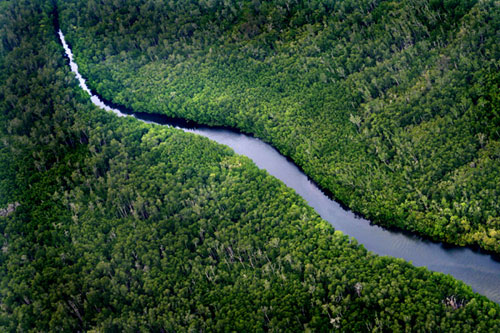
[Image: Sungai Wain Forest Reserve in East Kalimantan on the island of Borneo, Indonesia. Image source: Ahmad Fuadi/TNC]

Dale Steele
"Preste la atención a los cielos abiertos usted nunca sabe lo que bajará"
Saturday, April 28, 2012
Durian found in Sacramento!
Wow, some big news here as Laurie went out to a local asian market with a friend and came back with some tasty surprises. I know this won't be anything like the fresh produce we had every day while traveling around Indonesia but it is a start. They made an exploring trip for supplies after a tasty lunch at our favorite local Indo Cafe which gives us some flavor from home away from home. This will keep us going for the time being and allow us to introduce others to a little of the amazing foods we experienced in Indonesia.


Monday, April 2, 2012
A possible bike ride from Indonesia to Mecca? "Saya searing pemula"
Not me, at least there are no plans here for such a trip. I just came across this interesting Crazy Guy on a Bike forum discussion of someone in Blitar, Indonesia wanting to ride to the city of Mecca, UAE and wondering how to find more information for such a trip. As I've always found on the CGOAB site, there are many experienced travelers willing to share their knowledge and experience. This discussion is off to a good start, I plan to keep my eye on it to see where things go next.
Meanwhile, we did miss a chance for a bicycling adventure in Sulawesi while we were there and recently had a contact from the same person about another trip, this time in central Sulawesi. Too early to tell but this might just happen...
Meanwhile, we did miss a chance for a bicycling adventure in Sulawesi while we were there and recently had a contact from the same person about another trip, this time in central Sulawesi. Too early to tell but this might just happen...
Hi Laurie,
Did you get to Indonesia in January?
FYI the North Sulawesi trip went well, I think I can say that.
Upcoming trip is to Central Sulawesi .
13 - 28 May 2012.
907 km / 11 cycle days.
Best available accommodation. Fully supported. Swimming 15/16 days. Daily
yoga. Indonesian language instruction.
Details http://www.cycleindonesia.com.au/central_sulawesi.htm.
Would appreciate it if you could pass it on to BF people that you have
contact with. Thanks.
Colin
Sunday, April 1, 2012
Palm Oil and Deforestation
This is a heavy subject that has been much on my mind for some time and long before our trip. Our journeys did not take us through many of the large plantations that have destroyed the vast forests that Indonesia once had. Those forests have been gone for some time in most of the areas we visited. At the same time, this is not an historical event as the destruction continues at a rapid pace elsewhere in Indonesia. There are nearly 100 intentional fires burning now as a way to quickly remove forests and clear the way for these plantations which fuel much of the foods, soap, cosmetics, chemicals, bio-diesel and other industries used by all of us. The toll that this is taking on native wildlife, especially orang-utans, and over-all biodiversity is both shocking and un-necessary. Still, at the rate things are going this will be yet another disaster that we look back and wonder where we were when this happened. For now, I'm going to become more engaged on this issue now and plan to spend time visiting the "front line" on my next trip. Here's some background and suggested materials. I'll add more later.
Watch "Green The Film" and educate yourself on the way your activities contribute to this problem. “Green” is a film about the rainforest of Indonesia and follows a female orang-utan there. It is 48 min long, it is available for free download and copyright free for all non commercial screenings. The film has no narration, it is thus accessible to all nationalities. It was produced independently and free of all commercial or political attachment. Don’t hesitate to screen the film wherever you feel appropriate too.
<4/4/12> In an unfortunate follow-up to this situation, an Indonesian court has thrown out a case rather than put itself in the "awkward" position of hearing how intentional actions could shortly lead to the extinction of the orang-utan in Sumatra. An appeal to a higher court is expected.
Watch "Green The Film" and educate yourself on the way your activities contribute to this problem. “Green” is a film about the rainforest of Indonesia and follows a female orang-utan there. It is 48 min long, it is available for free download and copyright free for all non commercial screenings. The film has no narration, it is thus accessible to all nationalities. It was produced independently and free of all commercial or political attachment. Don’t hesitate to screen the film wherever you feel appropriate too.
<4/4/12> In an unfortunate follow-up to this situation, an Indonesian court has thrown out a case rather than put itself in the "awkward" position of hearing how intentional actions could shortly lead to the extinction of the orang-utan in Sumatra. An appeal to a higher court is expected.
Some Facts about Deforestation
Indonesia has one of the world’s worst deforestation rates, averaging at around 2 million hectares a year. In 1950 the forest cover of Indonesia was about 160 million hectares, today less than 48 million hectares are left.
Massive deforestation of Indonesia began in the 1970s with the expansion of the timber industry. Then came the pulp and paper industry followed by the palm oil industry. Today, the major driving force behind Indonesian deforestation comes from the international demand for palm oil to make biofuels. An October 2009 report by the United Nations Environment Programme (UNEP) found that: “95 per cent of the increased production of palm oil in Malaysia and Indonesia was driven by the growing demand for biodiesel”, and that “two-thirds of the current expansion of palm oil cultivation in Indonesia is based on the conversion of rainforests”.
This demand comes essentially from India, Europe and China who are all promoting palm oil biodiesel as tomorrow’s best renewable “green”energy to combat climate change. But reports show that converting forests into oil palm plantations for biofuel actually worsens climate change. Palm oil bio-diesel is not really about combating climate change, it is just about making money.
Indonesia is the largest palm oil producer in the world and plans to expand its palm oil plantations from the present 7 million hectares to 20 million hectares in the years to come.
Saturday, March 17, 2012


A view from Jakarta
Received a couple of photos taken today. One is a street vendor scene at night while waiting for an order of sate ayam and sate kambing. Yum, that food is calling from there :) as Eko and Nana were buying some for dinner across the street from Reza and Iin's home. Sure miss those good times.
The second photo is a very large insect hanging on the fence at home. It apparently eats in the rice paddy though.
Also some news about new jobs and busy times there but a three day weekend is coming next week. I don't think many were celebrating St. Patrick's day though.
The second photo is a very large insect hanging on the fence at home. It apparently eats in the rice paddy though.
Also some news about new jobs and busy times there but a three day weekend is coming next week. I don't think many were celebrating St. Patrick's day though.
Friday, March 9, 2012
Indonesian meal Sacramento style!
We have really been missing our nasi since we got home nearly a month ago.
Today we enjoyed an early evening bike ride to the local Indo Cafe and had a great meal while chatting about Jakarta and other things. Mmm, just what we needed. It would have been fun if Elle and family could have joined us. Lien kali!
Laurie had nasi goring and I had Sate ayam and we shared Tahu isi and were happily stuffed for our American river bike trail ride home as the sun was setting. We plan to go back for more soon.

Side one of the "special" menu

Waiting for her nasi

This meal reminds me of Indonesia!

Ah, Sate ayam!

First bite & fancy fork work

Happy Dale!
Wednesday, February 29, 2012
Masih lebih untuk datang--(still more to come)
<Having fun with Google Translate!>
Kami telah rumah selama lebih dari seminggu sekarang dan itu masih sulit dipercaya. Bahkan menjadi kembali bekerja dengan terlalu banyak hal untukdilakukan di sana adalah kenangan sehari-hari orang, tempat, dan petualangan.
Kami secara perlahan bekerja pada memperbarui blog untuk menambahkan informasi lebih lanjut dan foto juga. Ada beberapa topik baru seperti Kredit Karbon yang perlu ditambahkan juga. Saya menemukan diri saya masih mencoba untuk mencari tahu situasi lalu lintasdi sana dan melihat banyak orang lain telah juga. Berikut adalah beberapa videolalu lintas sepeda motor.
Tinggal dicari, lebih untuk datang!
We have been home for over a week now and that's still hard to believe. Even being back at work with too many things to do there are daily memories of people, places, and adventures. I find myself still trying to figure out the traffic situation there and see lots of others have been as well. Here's some video of motorbike traffic.
We are slowly working on updating the blog to add more information and photos too. There are some new topics like Carbon Credit that need to be added too.
Stay tuned, more
to come!
Kami telah rumah selama lebih dari seminggu sekarang dan itu masih sulit dipercaya. Bahkan menjadi kembali bekerja dengan terlalu banyak hal untukdilakukan di sana adalah kenangan sehari-hari orang, tempat, dan petualangan.
Kami secara perlahan bekerja pada memperbarui blog untuk menambahkan informasi lebih lanjut dan foto juga. Ada beberapa topik baru seperti Kredit Karbon yang perlu ditambahkan juga. Saya menemukan diri saya masih mencoba untuk mencari tahu situasi lalu lintasdi sana dan melihat banyak orang lain telah juga. Berikut adalah beberapa videolalu lintas sepeda motor.
Tinggal dicari, lebih untuk datang!
We have been home for over a week now and that's still hard to believe. Even being back at work with too many things to do there are daily memories of people, places, and adventures. I find myself still trying to figure out the traffic situation there and see lots of others have been as well. Here's some video of motorbike traffic.
 |
| Another creative food cart |
 |
| Breakfast & Kopi Memories |
to come!
Thursday, February 16, 2012
Back on the ground
We headed back home with a heavy heart and mixed feelings about leaving our friends and family in Indonesia at the end of our incredible trip there. Although it was extremely hard to leave, we also missed our family and friends back home. We arrived back in San Francisco after over 19 hours in the air starting Thursday afternoon in Jakarta then on to Singapore for a short stop, Hong Kong with a rushed change of planes, and home to SF. Singapore Airlines treated us well overall; we had time for three dinners, ice cream for dessert, and Laurie even managed to collect more playing cards.
Ellie and Theo picked us up at SFO and drove us home in great style. It was great to see them again. And, somehow, all of this travel took place in a single day...we were home 5 hours after we left, after 19 hours on the plane.
 |
| Nana took time off from work to see us off |
 |
| Dale & Laurie saying goodbye to "home" (Iin and Reza's house in Jakarta) |
 |
| Reza, Iin, Reza's mom, and Nana took us to the Airport |
 |
| Nana rode with the luggage to make sure it arrived |
 |
| Last meal on this trip at the airport coffee shop. |
 |
| Creative packing to get the Bali Starling painting home (it worked) |
 |
| Laurie will miss Reza's mama very much. |
Wednesday, February 15, 2012
(not) Ready to go
 |
| Our baggage increased over the 5 weeks of the trip. |
Our bags are packed and ready to go. We fly back this afternoon after five amazing weeks that have gone too quickly as we look back on the people we've met and places we've been in this too brief introduction to this diverse and incredible country.
We leave with much sadness at leaving behind so many new friends and people we consider family now. They have given us help and warmth and love as we stumbled about.
We aren't saying goodbye, only "see you later." We have many more things to do when we return and the list keeps growing as we learn more about Indonesia. Lien kali!
Last supper
In the afternoon we headed back into Jakarta traffic. We made our way to a large older shopping mall that consists of two connected tall buildings. Inside, there were more small shops squeezed into at least 6 floors. No space was wasted as I found when I tried to take a break on a small plastic stool and quickly determined that this was someone's "shop" with a tray of snacks and drinks tucked into a tiny space next to the stool.
We agreed it would be impossible to count the number of shops in this place. Many of them seemed to duplicate each other and I don't think I've ever seen so many watches, shoes, or shirts. Reza's mom is an excellent shopper who patiently examines each item she pulls from the rack before deciding on her bulk purchase. With 15 grandchildren, she has a lot of shopping to do. Laurie was also working from a list of gifts to take back. She's done a fine job of that too, only limited by our luggage space and the 23 kilo per bag (and 2 bags per person) limit we are held to.
After hours of shopping in this complex place we met with Nana and Eko and all packed into Reza's van (Nana and Eko in the very back) to head for another great dinner. Parking is a limiting factor and much creativity is needed to solve it. Reza is a master at this and we arrived in fine style.
 |
| Out on the town for our last night in Jakarta. |
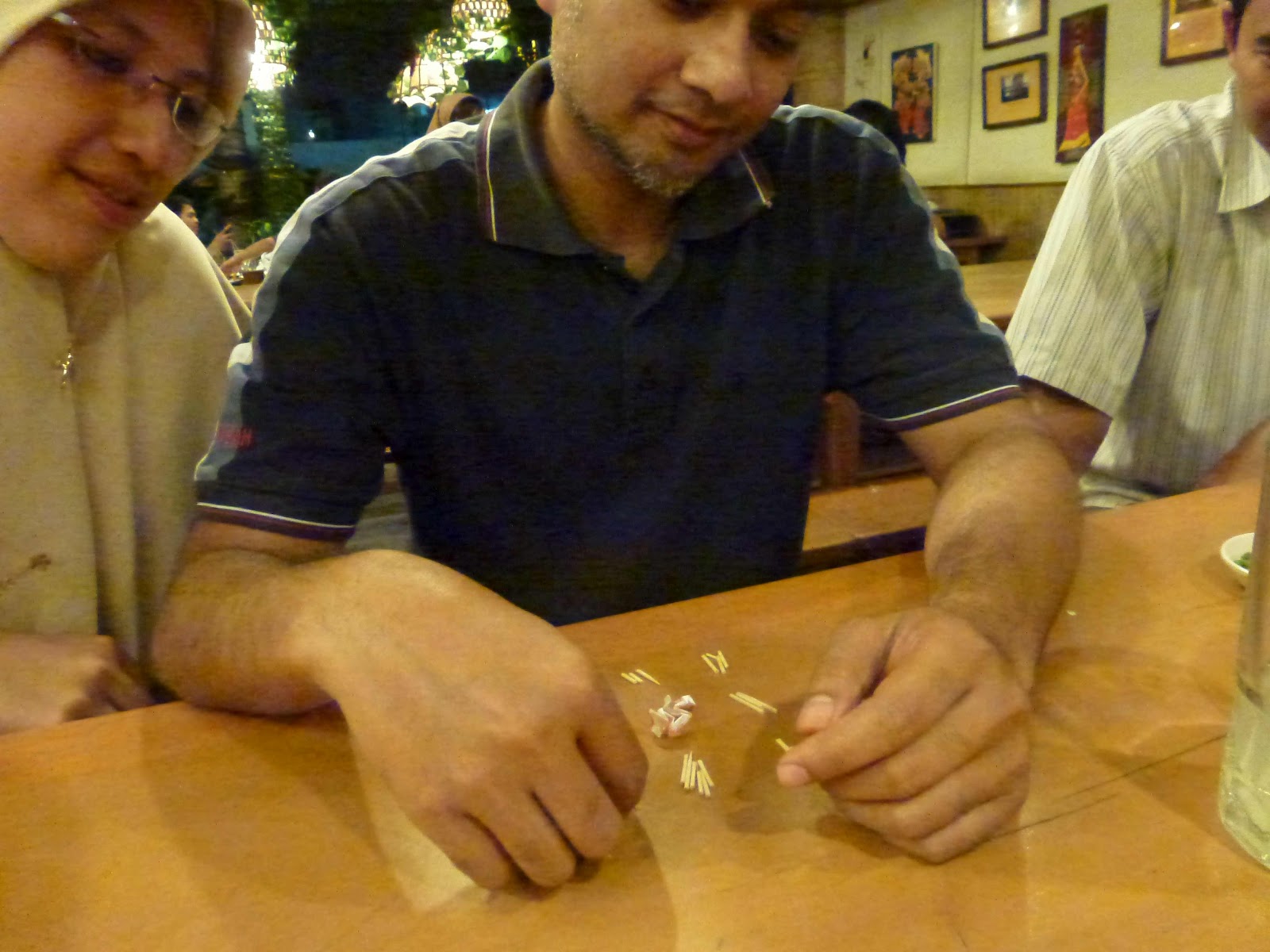 |
| Reza presents another mathematical puzzle. No one got the right answer. |
Tuesday, February 14, 2012
Butterfly time in Bandung!
We've finally had a chance to visit Bandung, which we've heard much good about since Nana was in Stockton 12 years ago. Reza and Iin took us up there along with Reza's mom who is also visiting now. We stayed at Iin's Aunt Dia's house and were shown a great time including food, fun, family, friends and much more. This large city is 2 or 3 hours from Jakarta and over 1000 meters higher in elevation with more forgiving temperatures and traffic as we learned on this trip.
We arrived late afternoon yesterday and visited Dia's restuarant for another delicious Padang meal. We've only had delicious meals the entire nearly 5 weeks we've been in Indonesia now. Afterwards, we went over to the home we'd be staying at to unpack and rest before setting out to find a butterfly park there.
The butterfly park proved to be very difficult to find and by the time we got there a very hard rain had arrived too. The butterflies were smart enough to seek cover so we did too as we headed back on a new route over the mountain and found just how narrow a two lane road can be. In this case the road was also quite steep and the rain came down quite hard as we pressed on to find our way back home.
We had quite a memorable time including some backtracking but eventually got back to town and had a great meal at a roadside stand, one of thousands we've passed in our travels here. We feasted on bbq corn with special seasoning and several other dishes we've never had yet in spite of our efforts to eat our way through Indonesia! We also stopped at a great roadside fruit stand and loaded up with many tasty items for sharing and breakfast the next day. After a stop at Dia's home we went back to her old house where we were staying the night.
We headed back on a different route and enjoyed a tasty meal downtown before going shopping in a large traditional marketplace where we made a few great purchases along with lots of "windowless" shopping and turning a few heads. Several more hours were spent running errands around town by "mobile" (auto) before we headed back to say goodbye for now.
Heading down to Jakarta traffic was heavy on the tollroad but we made it with some creative Indonesian style driving by Reza. Normal driving here includes many things that would shock and amaze US drivers like us. Trust me on that.
The household is nearly quiet now as I type this after the long day and hard driving we did. The TV is on and Reza's mom "watches" a program while resting on a mattress in the living room. It's been quite a day again...
We arrived late afternoon yesterday and visited Dia's restuarant for another delicious Padang meal. We've only had delicious meals the entire nearly 5 weeks we've been in Indonesia now. Afterwards, we went over to the home we'd be staying at to unpack and rest before setting out to find a butterfly park there.
 |
Family dining in Bandung
|
We had quite a memorable time including some backtracking but eventually got back to town and had a great meal at a roadside stand, one of thousands we've passed in our travels here. We feasted on bbq corn with special seasoning and several other dishes we've never had yet in spite of our efforts to eat our way through Indonesia! We also stopped at a great roadside fruit stand and loaded up with many tasty items for sharing and breakfast the next day. After a stop at Dia's home we went back to her old house where we were staying the night.
 |
BBQ Corn street vendor style!
|
 |
Iin shopping for fruit
|
 |
| Dinner at another great place to eat (the English menu was hilarious--we made photos of every page) |
 |
| I think I know this guy... |
Today started early, at least for Dina and the others living at the house (don't remember everyone's names), who prepared and served a large and tasty breakfast before Dina headed off to cook again at Dia's restaurant.
We headed out early to visit the nearby IBM building shaped as a sundial which is home of some great science exhibits and we enjoyed testing our skills and powers of deduction there.
We next headed back for the butterfly park before the rains got there again and eventually re-discovered it. We had the place nearly to ourselves for hours. We enjoyed many species we've never seen and managed to even photograph a few. Don't know the names, though, and the people there didn't have any books or lists on species. We were also offered some plant cuttings. This outing was a first for everyone in our group so we were happy to give them the excuse to visit the park.
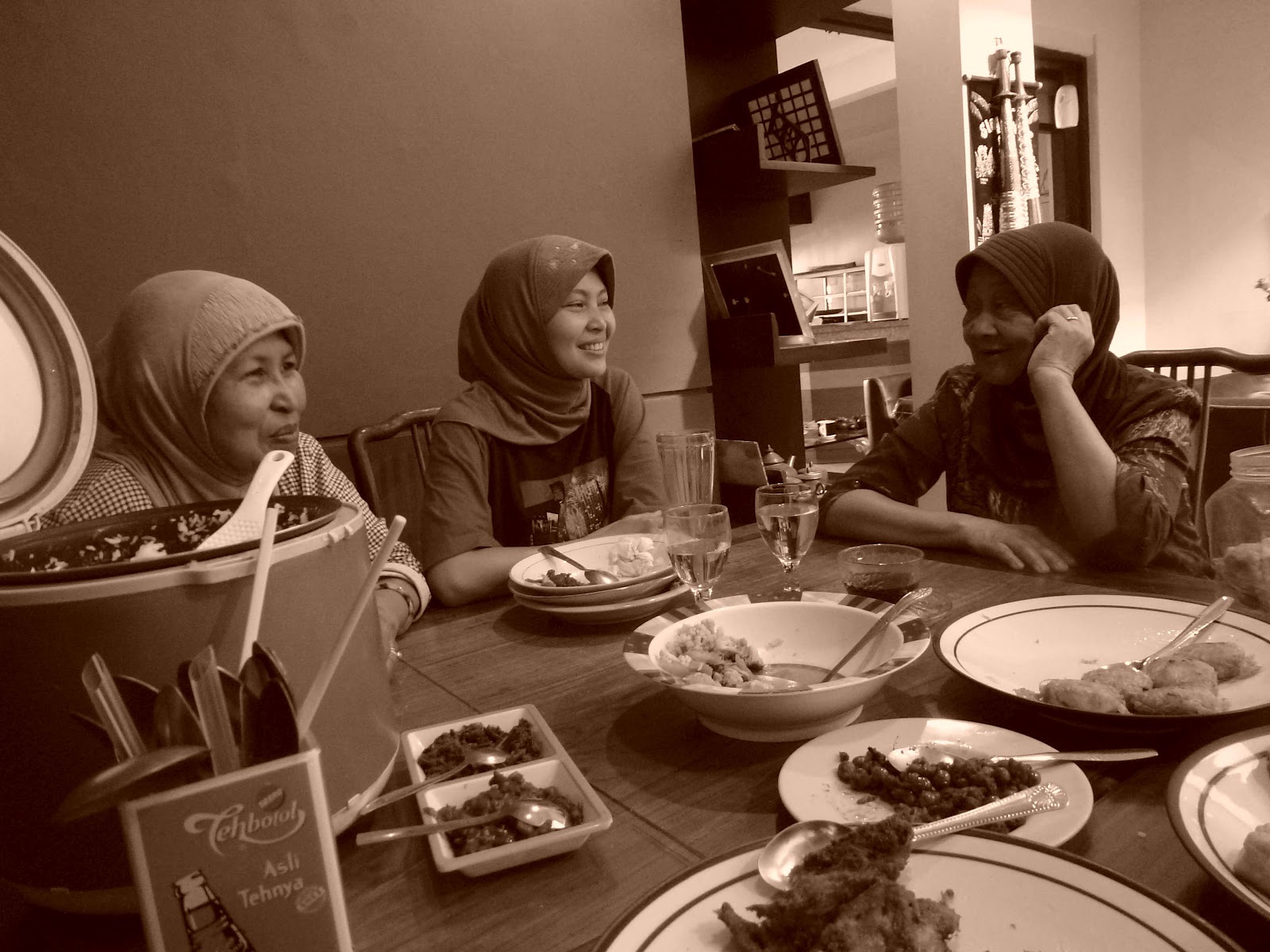 |
| Fabulous family breakfast of nasi goreng, mei goreng, perkadel (Laurie's favorite!), ayam goreng, and much more |
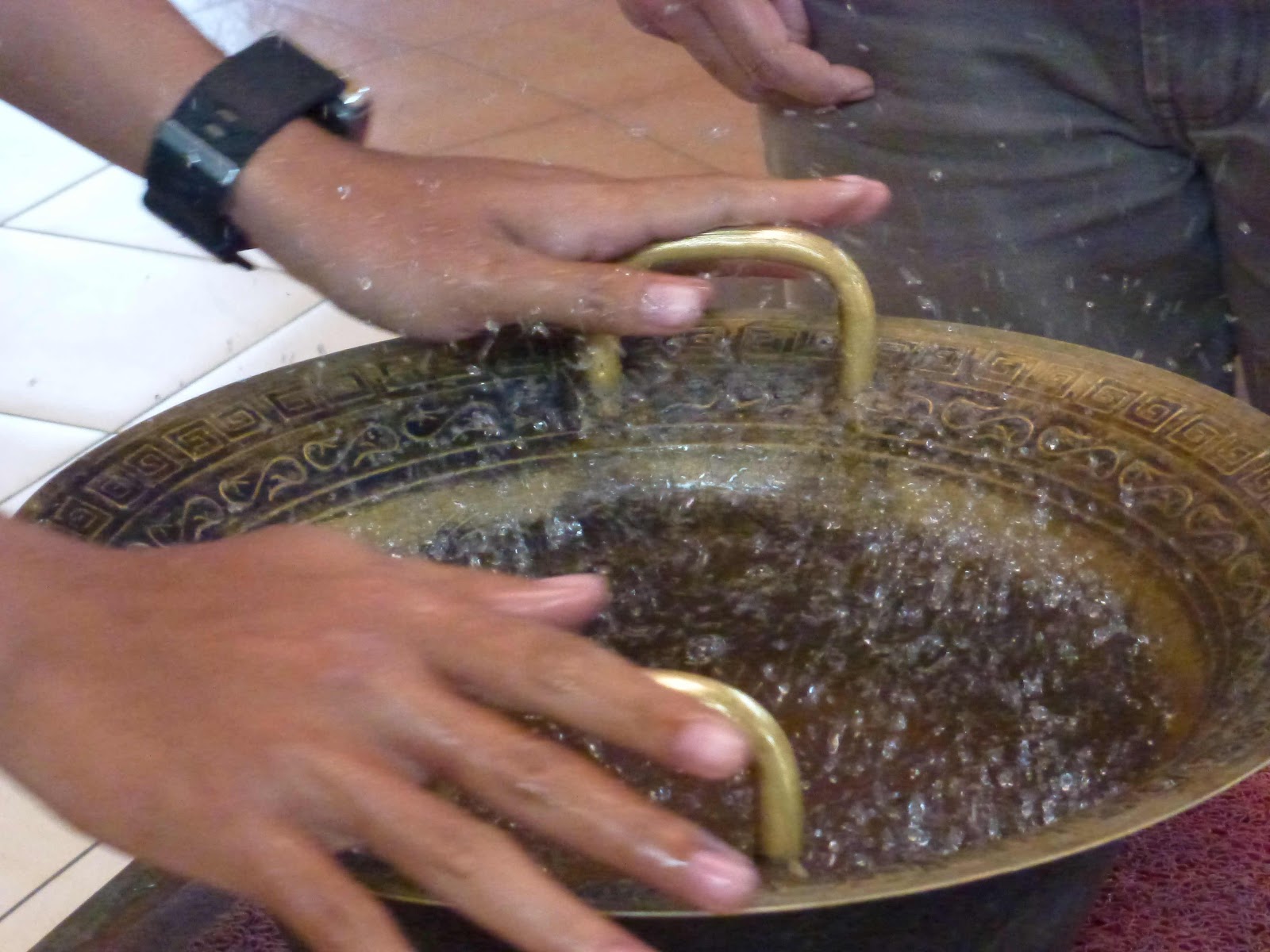 |
| Making water dance |
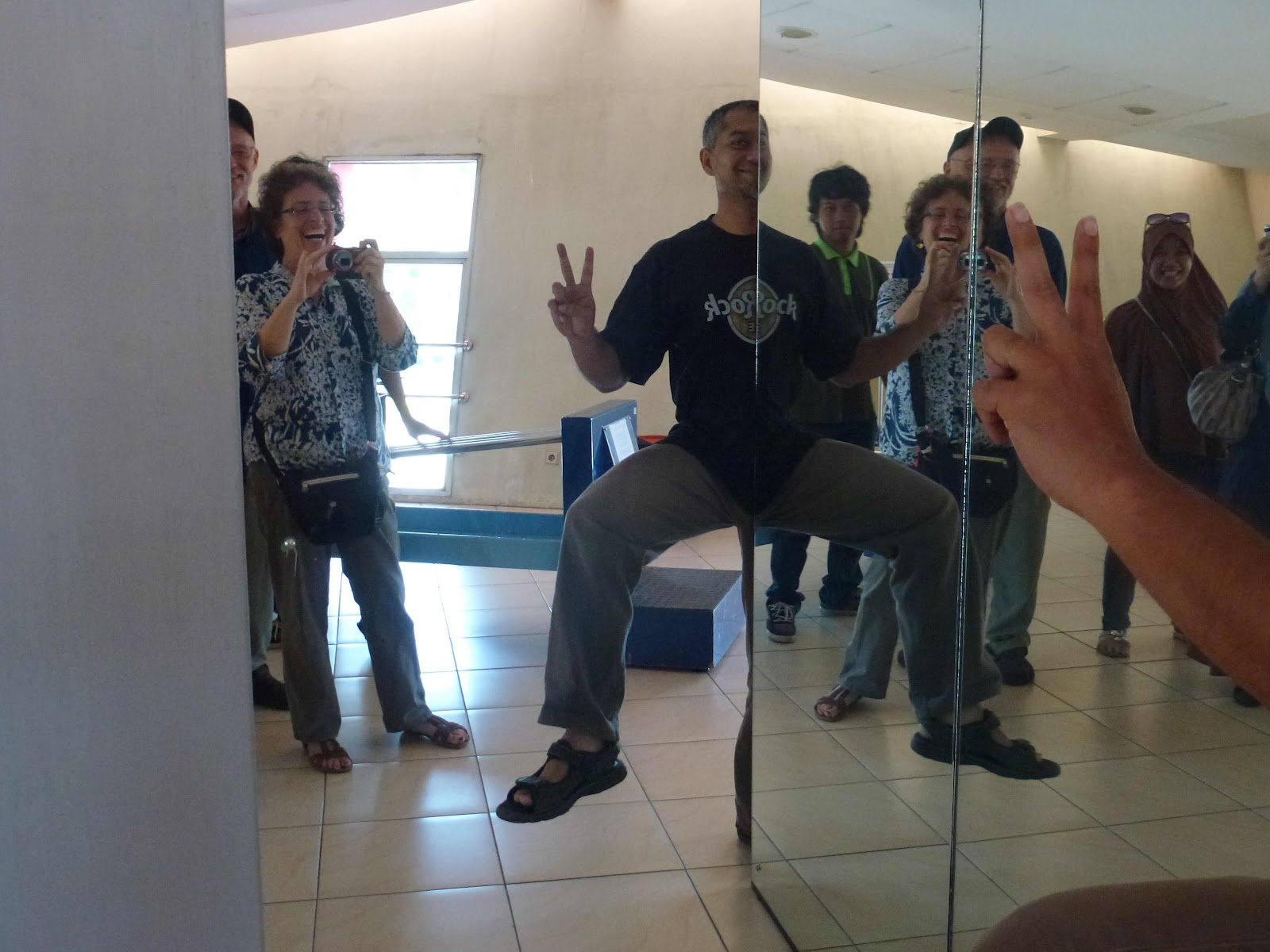 |
| Reza levitating |
 |
| Butterfly garden view |
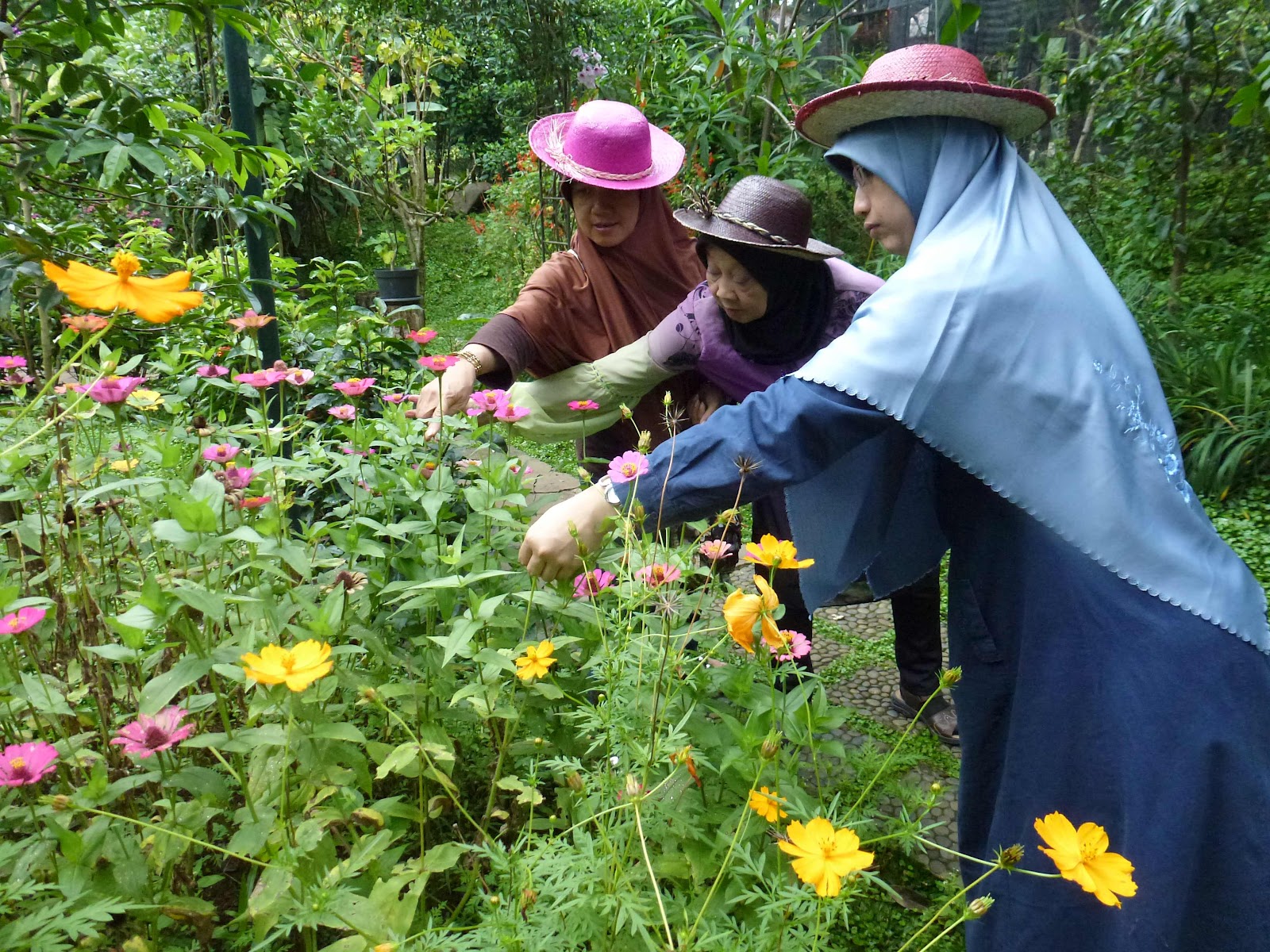 |
| Dia, Mama Reza, and Iin taking cuttings from the flowers. They gave us hats to wear when we bought the tickets. |
 |
| Two hats are better than one |
 |
| A beautiful butterfly |
 |
| Huge walking leaf insect! |
 |
| Just emerged |
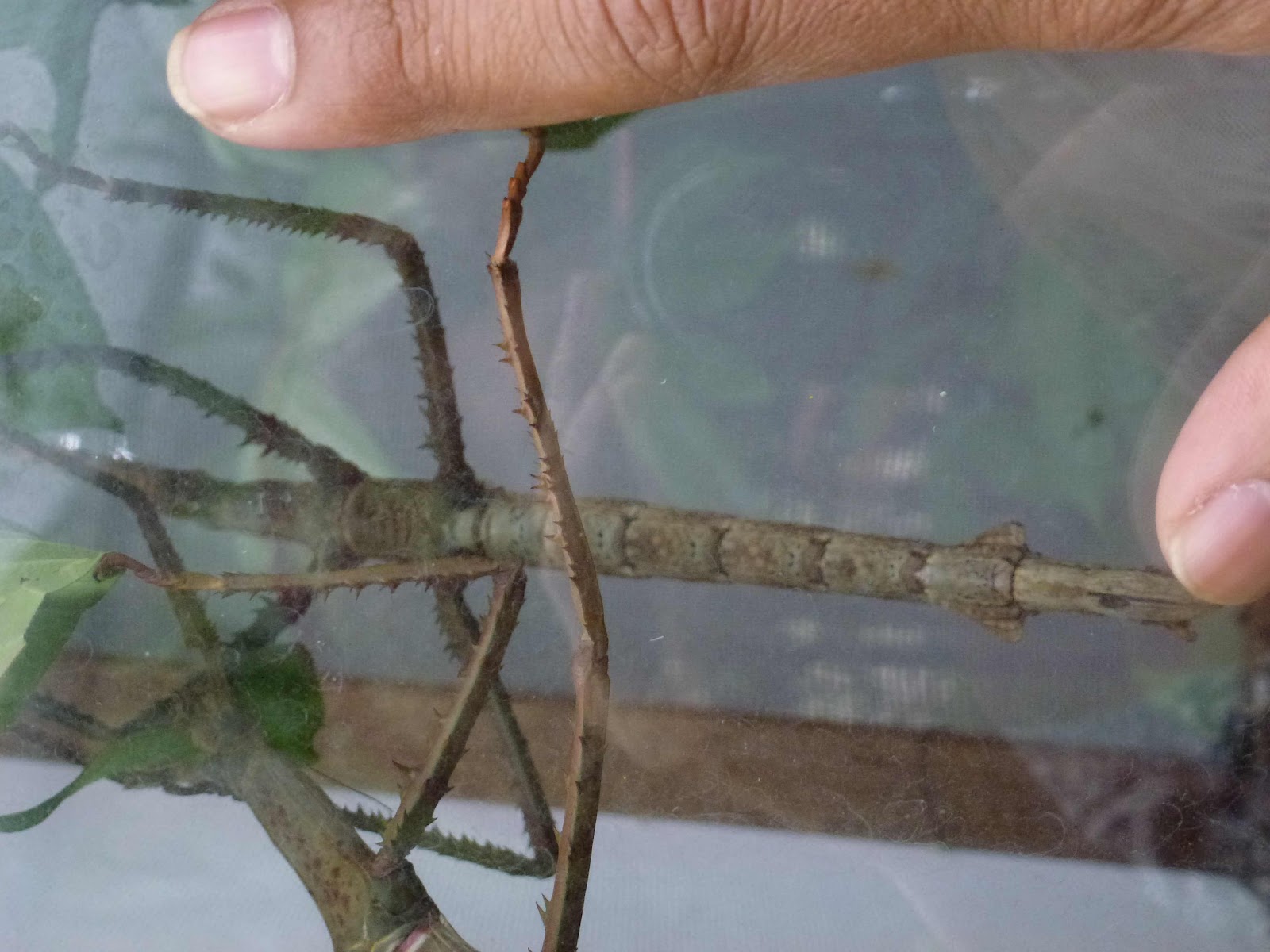 |
| Giant walking stick insect |
 |
| A great day at the butterfly park! |
Heading down to Jakarta traffic was heavy on the tollroad but we made it with some creative Indonesian style driving by Reza. Normal driving here includes many things that would shock and amaze US drivers like us. Trust me on that.
We got back into Jakarta around 7 and headed for one of the biggest malls in the city where Reza's brother was celebrating his birthday as well as that of his young son. We were welcomed into this family party and had an unforgettable time with three generations of the extended family. We stayed long enough to close out the mall which has to be a first for me and certainly made Nana proud even though she missed the party due to a 5 plus hour global video conference at her office. I don't miss things like that to say the least but I am beginning to think a little about work now that our trip is in the last few days.
Tomorrow we plan to have a slower day and spend time trying to pack our now bulging suitcases and determine how our trip to the airport will go the following day. There may be some last minute shopping or other surprises I suspect.
Sunday, February 12, 2012
Plan B today!
We spent some long hours today in Jakarta traffic with Nana driving, Iin paying tolls and navigating and Laurie and I "enjoying" the ride.
It was well worth it too as we joined a family wedding for Koko's wife Ayu's sister today. This friendly wedding was held at home & partially in the street & allowed us to meet family and friends, visit with Koko who was sick during our last visit, and enjoy more great Padang food.
When we headed home the plan was to pick up roast duck (Bebek) for everyone but traffic delays caused us to miss out as the place closed before we arrived. No worries, we drove on to another family favorite Padang spot where we were finally able to treat after Nana and Iin supervised the selection of dishes for each of us which were then wrapped in banana leaves and paper. We had another feast and struggled to finish the big portions.
We also got a good look at the large University of Indonesia where Obama recently spoke. This event is often mentioned when we tell people we are from America. The campus looks impressive and well appreciated with lots of students and others enjoying the many grounds we saw. This place looks worth further investigation "lien kali". I spotted a solar facility in front of one of the buildings too, one of the few times I'm seen solar panels here even though the conditions seem ideal for more.
We are sitting around now listening to the hard rain that has started again while we twitter about the day and wait for Eko to return from his off-shore weekend work project.
A good plan implemented today.
It was well worth it too as we joined a family wedding for Koko's wife Ayu's sister today. This friendly wedding was held at home & partially in the street & allowed us to meet family and friends, visit with Koko who was sick during our last visit, and enjoy more great Padang food.
When we headed home the plan was to pick up roast duck (Bebek) for everyone but traffic delays caused us to miss out as the place closed before we arrived. No worries, we drove on to another family favorite Padang spot where we were finally able to treat after Nana and Iin supervised the selection of dishes for each of us which were then wrapped in banana leaves and paper. We had another feast and struggled to finish the big portions.
We also got a good look at the large University of Indonesia where Obama recently spoke. This event is often mentioned when we tell people we are from America. The campus looks impressive and well appreciated with lots of students and others enjoying the many grounds we saw. This place looks worth further investigation "lien kali". I spotted a solar facility in front of one of the buildings too, one of the few times I'm seen solar panels here even though the conditions seem ideal for more.
We are sitting around now listening to the hard rain that has started again while we twitter about the day and wait for Eko to return from his off-shore weekend work project.
A good plan implemented today.
 |
| Note the large squid on my "plate" Yum! |
Subscribe to:
Posts (Atom)